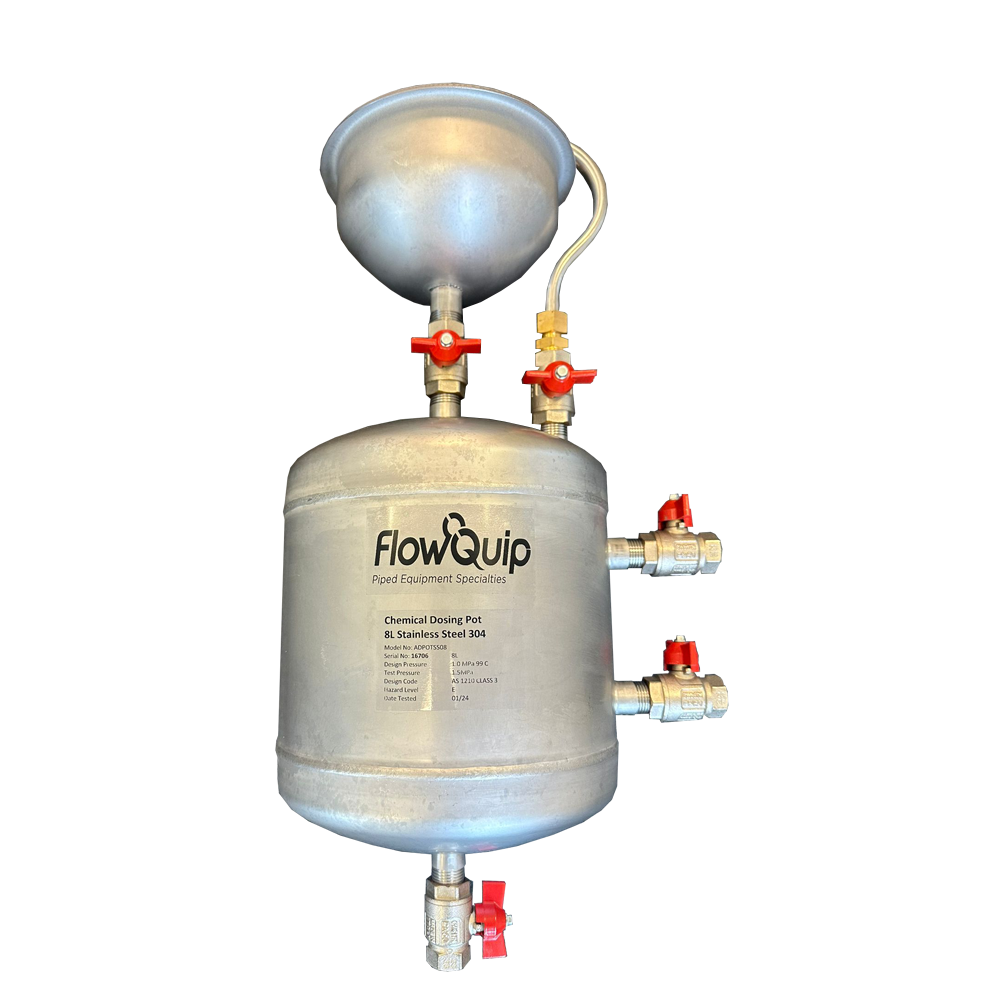




Stainless Steel Dosing Pot for HVAC, Heating & Chilled Water Systems
FlowQuip stainless steel chemical dosing pots are designed for safe, simple and controlled manual dosing of sealed heating, chilled water, hydronic and closed-loop HVAC systems.
A dosing pot allows liquid treatment chemicals such as corrosion inhibitors, glycol, cleaners and water-treatment additives to be introduced into a closed system without requiring a powered dosing pump. The pot is installed across the flow and return pipework, allowing a portion of system water to be isolated, drained and replaced with the chemical treatment. Once reconnected, the system flow carries the treatment through the circuit.
FlowQuip dosing pots are suitable for commercial mechanical services, HVAC plant rooms, hydronic heating systems, chilled water loops, heat pump systems and closed-loop water-treatment applications throughout New Zealand.
Available in 8L and 15L stainless steel models, these dosing pots are supplied with a funnel and valve arrangement for isolation, filling, draining and dosing control.
Why Use a Stainless Steel Chemical Dosing Pot?
Chemical dosing is an important part of maintaining closed-loop heating and cooling systems. Correct dosing helps protect pipework, valves, heat exchangers, pumps and system components from corrosion, fouling and poor water quality.
A stainless steel dosing pot is a strong option for HVAC water treatment because it does not introduce rust or iron into the system. Compared with mild steel or carbon steel pots, stainless steel offers better resistance to corrosion and helps reduce the risk of sludge, magnetite and unwanted contamination entering the circuit.
FlowQuip stainless steel dosing pots are designed for long service life and simple manual operation in New Zealand commercial HVAC and hydronic systems.
Key Features
- Stainless steel chemical dosing pot for closed-loop systems
- Available in 8L and 15L sizes
- Suitable for sealed heating and chilled water systems
- Ideal for HVAC, hydronic heating and plant room applications
- Used for inhibitors, glycol and other water-treatment chemicals
- Funnel and valve arrangement for filling, draining and re-dosing
- Supplied with ball valves for dosing control
- 304 stainless steel construction
- No electrical power or dosing pump required
- Helps avoid adding rust or iron contamination into the system
- Suitable for regular manual chemical treatment and maintenance
Common Applications
FlowQuip chemical dosing pots are commonly used for:
- Commercial HVAC systems
- Hydronic heating systems
- Chilled water systems
- Closed-loop water-treatment circuits
- Boiler and heat pump plant rooms
- Glycol dosing
- Corrosion inhibitor dosing
- System cleaner and flushing chemical dosing
- Mechanical services maintenance
- Building services water treatment
How a Dosing Pot Works
A dosing pot is installed across the flow and return lines of a closed water system. During dosing, the pot is isolated from the main circuit using the inlet and outlet valves. The operator drains the pot, fills it with the required chemical through the funnel, closes the fill and drain valves, then reopens the isolation valves so the chemical is flushed into the system.
This makes a dosing pot a practical option for maintenance teams and contractors who need to add treatment chemicals without installing a continuous chemical dosing pump.
Stainless Steel vs Mild Steel Dosing Pots
Stainless steel dosing pots offer several advantages over mild steel or carbon steel alternatives in closed-loop water systems.
Stainless steel is more resistant to corrosion from water and chemical treatment products. It does not contribute rust or iron contamination to the system, helping reduce the chance of sludge and magnetite build-up. The smooth stainless steel surface also makes it harder for deposits to adhere inside the vessel.
For commercial HVAC and hydronic systems where long-term water quality matters, stainless steel is often the preferred material for chemical dosing pots.
Dosing Pot Installation Overview
The FlowQuip dosing pot is installed across the system flow and return lines. The flow connection should be taken from the flow line or circulating pump discharge side, while the return connection should be taken back to the return line or pump suction side.
A drain connection allows the pot to be emptied before filling with the treatment chemical. The air vent allows trapped air to be released during filling, reducing the chance of introducing air into the system.
Always follow the project specification, site procedures and chemical supplier instructions when dosing a system.
Basic Dosing Procedure
- Close the isolation valves to isolate the dosing pot from the main circuit.
- Open the fill, air vent and drain valves to empty the pot.
- Close the drain valve.
- Fill the dosing pot with the required chemical through the funnel.
- Close the fill and air vent valves to seal the pot.
- Open the isolation valves to allow system flow through the dosing pot.
- Allow sufficient time for the chemical treatment to mix through the system.
- Isolate the pot again if required after dosing is complete.
Why Choose FlowQuip?
FlowQuip supplies stainless steel dosing pots for New Zealand HVAC, hydronic and mechanical services applications. Our dosing pots are designed for practical site use, with 8L and 15L options available for contractors, installers and maintenance teams working on sealed heating and chilled water systems.
Contact FlowQuip for project pricing, availability, technical information or help selecting the correct dosing pot for your system.
Frequently Asked Questions
What is a dosing pot?
A dosing pot is a small vessel used to manually add liquid chemicals into a sealed heating, chilled water or closed-loop HVAC system. It allows treatment chemicals to be introduced without shutting down major equipment or installing a powered dosing pump.
What is a chemical dosing pot used for?
A chemical dosing pot is used to add corrosion inhibitors, glycol, cleaners and other water-treatment chemicals into closed-loop systems. These chemicals help protect pipework, pumps, valves, heat exchangers and other components from corrosion, fouling and poor water quality.
Can a dosing pot be used on chilled water systems?
Yes. FlowQuip stainless steel dosing pots are suitable for sealed chilled water systems as well as heating, hydronic and other closed-loop HVAC systems.
Can a dosing pot be used on heating systems?
Yes. Dosing pots are commonly used on sealed heating systems to add inhibitor, glycol or other treatment chemicals into the circuit.
Do I need a dosing pump?
No. A dosing pot is designed for manual chemical dosing and does not require electrical power or a chemical dosing pump. The system flow carries the chemical treatment through the circuit after the dosing pot is reconnected.
What size dosing pot do I need?
FlowQuip offers 8L and 15L stainless steel dosing pots. The right size depends on the system volume, the amount of chemical being added and the dosing frequency. For larger commercial HVAC and hydronic systems, the 15L model is commonly selected.
What chemicals can be added through a dosing pot?
Typical chemicals include corrosion inhibitors, glycol, system cleaners, flushing chemicals and other closed-loop water-treatment additives. Always check compatibility with the system materials and follow the chemical supplier’s instructions.
Why choose stainless steel instead of mild steel?
Stainless steel offers better resistance to corrosion and does not add rust or iron contamination into the system. This helps reduce the risk of sludge, magnetite and poor water quality in closed-loop systems.
Where is the dosing pot installed?
A dosing pot is usually installed across the flow and return pipework of a closed system. It is isolated during filling and then reconnected so the system flow can carry the chemical into the circuit.
Is this dosing pot suitable for New Zealand HVAC systems?
Yes. FlowQuip supplies stainless steel dosing pots for New Zealand HVAC, hydronic heating, chilled water and mechanical services applications.
Installation
Valve D must be connected to the flow line, or circulating pump discharge line.
Valve C must be connected to the return line, or circulating pump suction line.
Valve E is connected to drainage.
Dosing Procedure
Close isolating Valves C & D.
Open the dosing pot fill Valve A, air-venting Valve B, & drain Valve E, to empty pot.
Close drain Valve E, and fill the dosing pot with the appropriate product through the funnel.
Close valves A & B to seal pot.
Open isolation Valves C & D to allow circulation through the pot into the system to be treated. Allow sufficient time for chemical treatment to be mixed into the main system.
Close Valves C & D to isolate the pot from the main system.
Alternative Products
These other products might interest you
Accessories Products

To install this Web App in your iPhone/iPad press
 and then Add to Home Screen.
